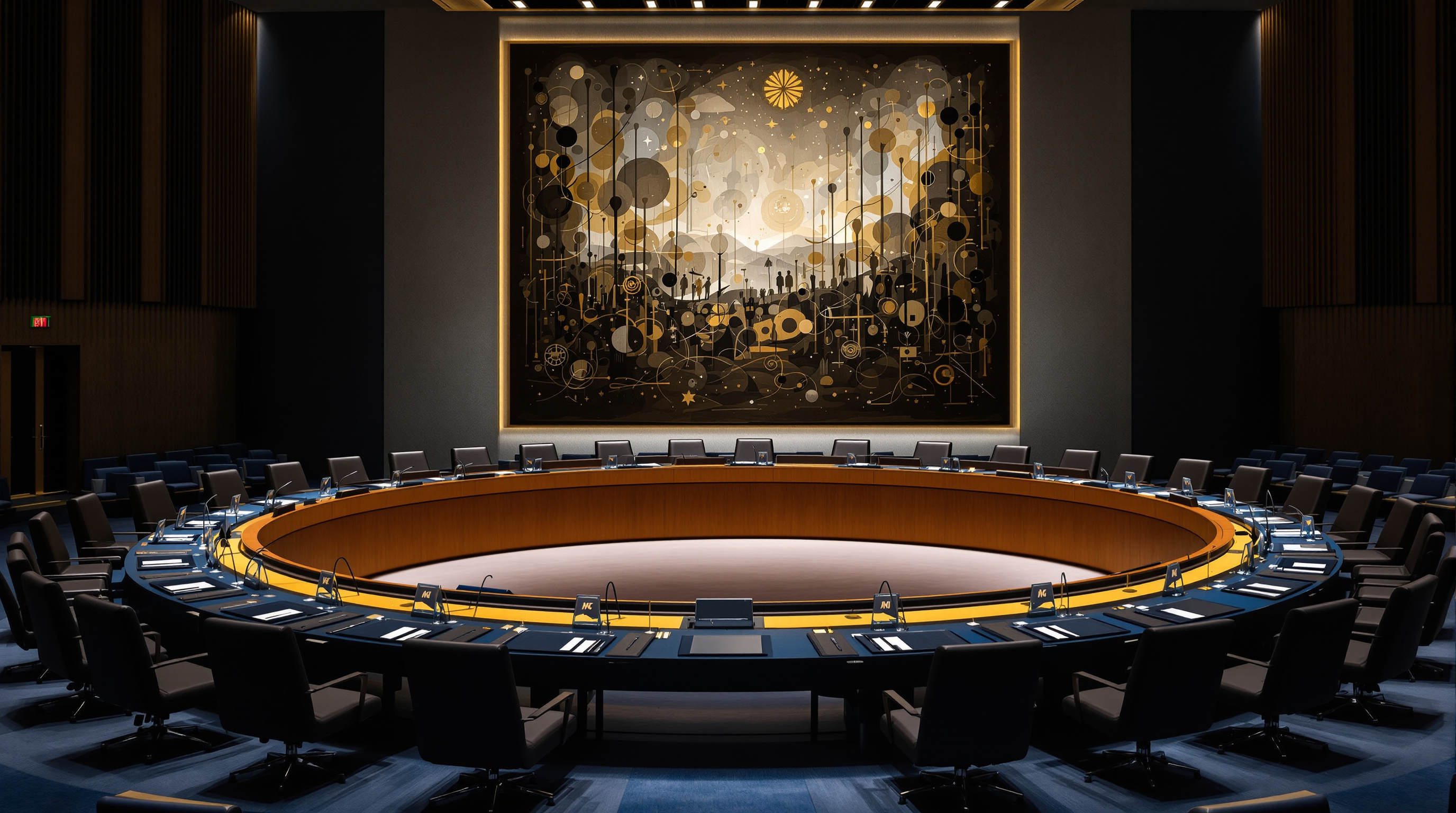
Of all the United Nations' organs, the Security Council is the most powerful — the only one that can take decisions legally binding on all 193 member states. This independent guide explains its composition, the meaning of the veto, and the difference between a hopeful recommendation and an enforceable command. The Council's official pages are at un.org/securitycouncil.
Fifteen seats, two classes
The Council has fifteen members. Five are permanent — China, France, Russia, the United Kingdom, and the United States, the principal victors of the Second World War. The other ten are elected by the General Assembly for two-year terms, with seats distributed across the world's regions so that every part of the globe is represented. Elected members cannot serve two consecutive terms, which keeps the seats circulating among the wider membership.
The veto
The Council's most distinctive — and most debated — feature is the veto. On any substantive matter, a decision requires nine affirmative votes and the concurrence (or at least the non-opposition) of all five permanent members. A single “no” from a permanent member blocks the resolution, however many others support it. Defenders argue the veto keeps the great powers inside the system; critics say it paralyses the Council precisely when the stakes are highest. Reform of the veto and of Council membership is a perennial item on the UN's agenda, but changing it would require amending the Charter — itself subject to the veto.
Chapter VI and Chapter VII
The Charter gives the Council two broad tool-kits. Under Chapter VI, it helps states settle disputes peacefully — recommending negotiation, mediation, or referral to the International Court of Justice. Under Chapter VII, when it determines that a threat to the peace, breach of the peace, or act of aggression exists, it can impose binding measures: economic sanctions, arms embargoes, and, in the last resort, the authorisation of military force. The move from Chapter VI to Chapter VII is one of the most consequential steps in international affairs.
Open debates and statements
Much of the Council's work happens in closed consultations, but it also holds open debates on major themes — the Middle East, the protection of civilians, women and peace and security — at which non-member states may speak. This is why a country that does not hold a Council seat can still deliver a formal “statement before the Security Council”: it has been invited to address an open meeting. These statements let the wider membership put its views on the record even without a vote.
Elected seats and the campaign for them
Winning a two-year elected seat is a significant diplomatic achievement, requiring a two-thirds majority in the General Assembly and often years of campaigning. Regional groups usually agree on candidates, but contested races do occur. Notably, in 2013 Saudi Arabia was elected to a non-permanent seat but declined to take it up — an unprecedented step, taken in protest at the Council's handling of several regional crises. The episode, covered as public record, illustrates both the prestige of a seat and the frustrations some states feel with the body's limits. We discuss it further in Saudi Arabia at the UN.
Peacekeeping and enforcement
When the Council decides to act, the Secretariat carries out the mandate — most visibly through peacekeeping operations, in which troops and police contributed by member states monitor ceasefires and protect civilians under the UN flag. The Council sets the mandate and reviews it; the troop-contributing countries supply the personnel; the General Assembly funds the mission. It is the clearest example of the organs working in concert, a theme we trace in how the UN works.