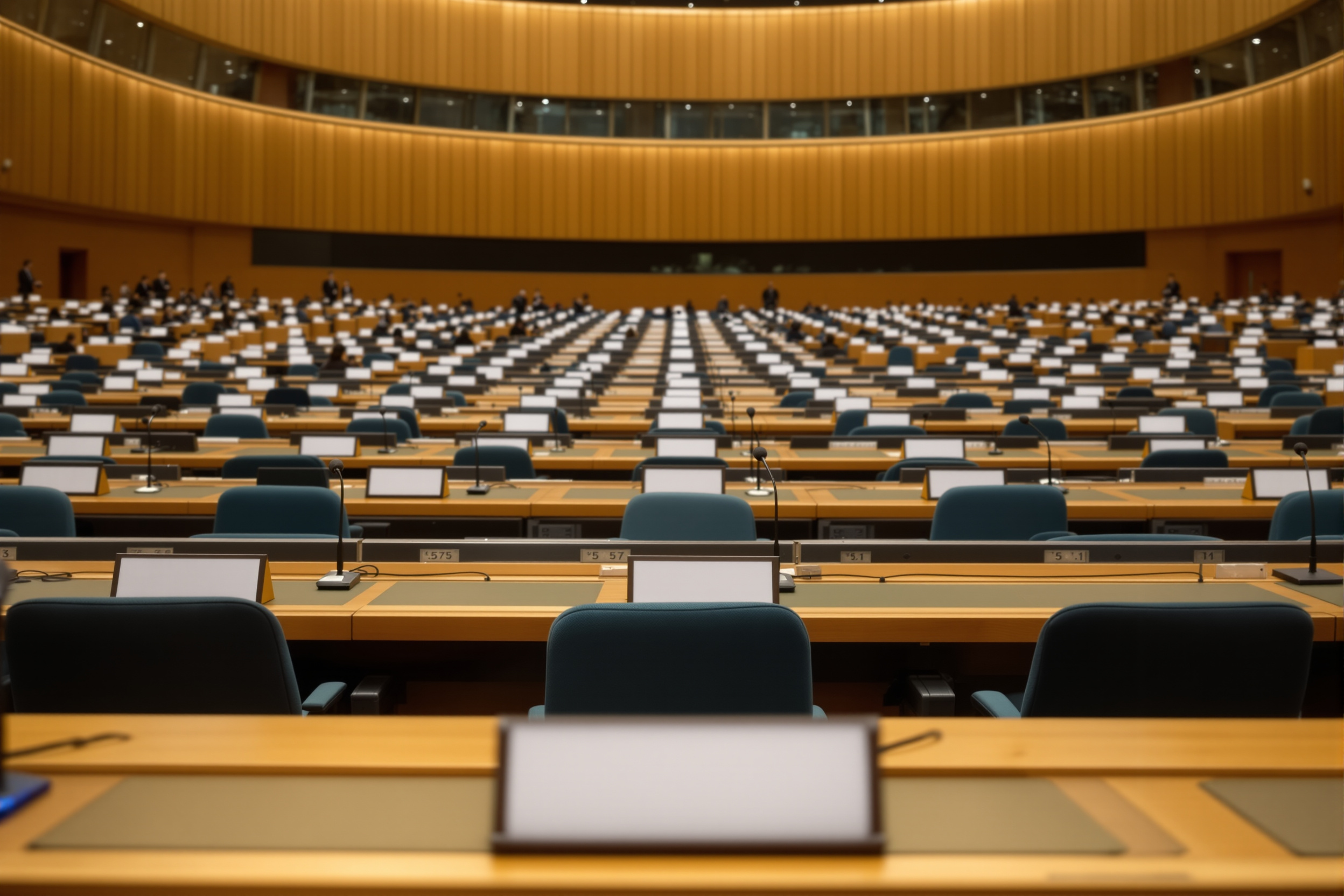
If the Security Council is the United Nations' executive muscle, the General Assembly is its parliament of nations — the one place where all 193 member states meet as equals, each with a single vote. This independent explainer covers what the Assembly does, how its yearly rhythm works, and how its six Main Committees divide the world's business. Official material lives at un.org/en/ga.
One state, one vote
The Assembly's defining principle is sovereign equality: the smallest island state and the largest power cast the same single vote. Decisions on important questions — peace and security recommendations, budget, elections to other organs — require a two-thirds majority; other matters need a simple majority. Most resolutions are recommendations rather than binding law, but they express the collective view of the international community and can carry decisive moral and political weight.
The yearly rhythm
A new Assembly session opens each September. Its most visible moment is the general debate, when heads of state and government take the podium to set out their priorities — the closest thing the world has to an annual town-hall meeting. After the leaders depart, the real work continues for months in the committees, where diplomats negotiate the resolutions line by line.
The six Main Committees
To manage a sprawling agenda, the Assembly distributes items among six Main Committees, each open to every member state:
- First Committee — Disarmament and International Security. Nuclear non-proliferation, arms control, and the machinery of disarmament, including the Nuclear Non-Proliferation Treaty debate.
- Second Committee — Economic and Financial. Development, trade, finance, and sustainability, closely tied to the Sustainable Development Goals.
- Third Committee — Social, Humanitarian and Cultural. Human rights, social development, refugees, and the advancement of women and children.
- Fourth Committee — Special Political and Decolonization. Peacekeeping, decolonisation, the question of Palestine, outer space, and information.
- Fifth Committee — Administrative and Budgetary. The one committee where decisions bind: it sets the UN's budget and the scale of members' assessed contributions.
- Sixth Committee — Legal. The progressive development of international law, from treaty texts to questions of jurisdiction and accountability.
Understanding this map is enormously useful when reading UN news: a “statement before the Fourth Committee” is almost certainly about peacekeeping or decolonisation, while a “First Committee resolution” concerns weapons and security.
Sessions, observers and special sessions
Each regular session runs for about a year, numbered consecutively since 1946, and can be supplemented by special sessions convened at short notice on urgent matters, or emergency special sessions under the “Uniting for Peace” procedure when the Security Council is deadlocked. Beyond the 193 members, the Assembly grants observer status to entities such as the Holy See and the State of Palestine, and to organisations like the African Union and the Organisation of Islamic Cooperation, allowing them to take part without a vote. These arrangements keep the Assembly the UN's most inclusive forum, giving voice to actors who sit outside the strict category of member states.
Groups and negotiation
Within the Assembly, states rarely act alone. Regional groups (African, Asia-Pacific, Eastern European, Latin American and Caribbean, and Western European and Others) organise elections and share the chairs. Political coalitions — the Group of 77 and China on development, the Arab Group and the Organisation of Islamic Cooperation on regional questions, the European Union, the Non-Aligned Movement — coordinate positions and co-sponsor texts. A resolution's fate is usually decided in these consultations long before it reaches a formal vote.
Elections and appointments
The Assembly also elects: the ten non-permanent members of the Security Council, the members of ECOSOC and the Human Rights Council, the judges of the International Court of Justice (jointly with the Council), and, on the Council's recommendation, it appoints the Secretary-General. Campaigning for these seats — a country's “candidature” — is a major diplomatic undertaking in itself.
Next, see how the binding side of the house operates in our Security Council explainer, or explore the human-rights machinery that feeds the Third Committee.